
From Shiz to the Emerald City, Wicked reimagines Oz through Elphaba and Glinda’s unlikely friendship.
This mega-hit blends soaring songs, smart satire, and spectacular stagecraft.
Dive into 168 hand-picked Broadway Wicked trivia questions, starting simple, then leveling up, to challenge superfans and newcomers alike.
Origins & Source Material
Q: What book is the musical Wicked based on?
A: Gregory Maguire’s 1995 novel Wicked: The Life and Times of the Wicked Witch of the West.
Q: Who wrote that novel?
A: Gregory Maguire.
Q: Which classic Oz creator inspired Maguire’s reimagining?
A: L. Frank Baum.
Q: How does the novel’s tone compare to the musical’s?
A: Darker, more political, and more adult.
Q: Who adapted the novel into a stage script (the musical’s “book”)?
A: Winnie Holzman.
Q: Who composed the musical’s score and lyrics?
A: Stephen Schwartz.
Q: Which studio initially held the screen rights that ultimately helped launch the stage project?
A: Universal Pictures (via Universal Stage Productions).
Q: Name two lead producers who shepherded Wicked to Broadway.
A: Marc Platt and David Stone (with Universal Stage Productions).
Q: Where did Wicked have its pre-Broadway tryout?
A: San Francisco.
Q: What was the pre-Broadway theater in San Francisco?
A: The Curran Theatre.
Q: In what year did those San Francisco tryouts take place?
A: 2003 (late spring/early summer).
Q: Compared with Baum’s and MGM’s Oz, what key perspective shift does Wicked make?
A: Elphaba becomes a misunderstood heroine rather than a one-note villain.
Q: What major political issue drives the musical’s Oz?
A: Anti-Animal discrimination and authoritarian control.
Q: Which relationship sits at the narrative core of Wicked?
A: The friendship between Elphaba and Galinda/Glinda.
Q: How does the musical generally “soften” the novel?
A: It reduces violence/sexual content and streamlines backstories.
Q: What musical motif often noted by fans nods to a famous Oz melody?
A: The “Unlimited” motif, frequently compared to the opening of “Over the Rainbow.”
Q: Whose parentage is hinted to differ between book and stage?
A: Elphaba’s—onstage, the Wizard is implied to be her biological father.
Q: Which artifact becomes the key to spellcasting in both versions?
A: The Grimmerie.
Q: What is Elphaba’s surname (from Maguire’s world)?
A: Thropp.
Q: What overarching theme does the title Wicked spotlight?
A: Moral ambiguity—who decides what “wicked” means?
Q: How far does the musical’s story arc extend compared with Maguire’s multi-book saga?
A: The musical focuses on Elphaba’s Shiz years through the Wizard conflict, ending earlier than the novels’ broader timeline.
Broadway Beginnings & Creative Team
Q: What Broadway theater has housed Wicked since its opening?
A: The Gershwin Theatre.
Q: In what year did Wicked officially open on Broadway?
A: 2003.
Q: What was the official Broadway opening date?
A: October 30, 2003.
Q: Who directed the original Broadway production?
A: Joe Mantello.
Q: Who choreographed the original production?
A: Wayne Cilento.
Q: Who designed the show’s clockwork-Oz scenic world?
A: Eugene Lee.
Q: Who created the iconic emerald-hued costumes?
A: Susan Hilferty.
Q: Who designed the lighting that paints Oz in eerie greens and golds?
A: Kenneth Posner.
Q: Who designed the sound for the Broadway production?
A: Tony Meola.
Q: Who orchestrated Stephen Schwartz’s score for the original production?
A: William David Brohn.
Q: Who handled vocal/arrangement supervision on the original?
A: Stephen Oremus.
Q: Name the original Broadway Elphaba.
A: Idina Menzel.
Q: Name the original Broadway Glinda.
A: Kristin Chenoweth.
Q: Who originated Fiyero on Broadway?
A: Norbert Leo Butz.
Q: Who originated Madame Morrible on Broadway?
A: Carole Shelley.
Q: Who originated the Wizard on Broadway?
A: Joel Grey.
Q: When did Broadway previews begin?
A: Early October 2003.
Q: Which companies are the headline producers behind Wicked?
A: Universal Stage Productions, Marc Platt, and David Stone.
Q: What label released the original Broadway cast album?
A: Decca Broadway.
Q: Which eye-catching set piece looms above the proscenium?
A: The Time Dragon Clock.
Q: What dominant color palette became Wicked’s unmistakable brand?
A: Green and black.

Characters & Relationships
Q: Who are the two central roommates-turned-best-friends at Shiz?
A: Elphaba and Galinda/Glinda.
Q: What color is Elphaba’s skin?
A: Green.
Q: Which carefree prince enters as a romantic interest?
A: Fiyero.
Q: What is the name of Elphaba’s younger sister who uses a wheelchair?
A: Nessarose.
Q: Which Munchkin pines for Glinda before dating Nessarose?
A: Boq.
Q: Which goat professor mentors Elphaba at Shiz?
A: Doctor Dillamond.
Q: Who is the charismatic, manipulative ruler of Oz?
A: The Wizard.
Q: Which power-wielding administrator corrals Shiz students and public opinion?
A: Madame Morrible.
Q: What name change does Galinda make early in the show?
A: She becomes Glinda.
Q: Who becomes the new governor of Munchkinland?
A: Nessarose.
Q: Which character is transformed into the Tin Man?
A: Boq.
Q: Which character is strongly implied to become the Scarecrow?
A: Fiyero.
Q: The lion cub freed at Shiz is later known as whom?
A: The Cowardly Lion.
Q: What is Elphaba’s family name?
A: Thropp.
Q: Fiyero is a prince from what region?
A: The Vinkus.
Q: Who “dates” Nessarose out of obligation after a misunderstanding?
A: Boq.
Q: Which character can seemingly conjure storms with a spell?
A: Madame Morrible.
Q: Who gifts Nessarose the enchanted shoes?
A: Elphaba.
Q: Whose biological father is implied to be the Wizard?
A: Elphaba.
Q: Who is Chistery?
A: The lead winged monkey.
Q: What ancient tome do characters use for powerful magic?
A: The Grimmerie.
Plot & Themes
Q: Where do Elphaba and Galinda first collide as classmates?
A: Shiz University.
Q: What climactic moment closes Act I?
A: Elphaba takes flight during “Defying Gravity.”
Q: What initial hope motivates Elphaba to seek the Wizard?
A: She wants to help Animals.
Q: What tool of rule does the Wizard rely on?
A: Propaganda and fear.
Q: What happens to Doctor Dillamond during Act I?
A: He’s removed/silenced due to anti-Animal policies.
Q: What event brands Elphaba as “wicked” in Ozian eyes?
A: Rejecting the Wizard’s manipulative agenda and fleeing.
Q: How do Glinda and Elphaba part emotionally in Act II?
A: Through forgiveness in “For Good.”
Q: What tragedy is politicized to vilify Elphaba?
A: Nessarose’s death beneath a falling house.
Q: Who is implied to summon the tornado that brings Dorothy?
A: Madame Morrible.
Q: What becomes of Elphaba at the supposed “melting”?
A: She fakes her death and escapes.
Q: What looming contraption symbolizes the Wizard’s deception?
A: The giant mechanical head.
Q: What does Elphaba’s green skin represent thematically?
A: Otherness and prejudice.
Q: What theme does “Popular” gleefully poke fun at?
A: Superficial social status.
Q: Under the Wizard’s pressure, what transformation does Elphaba unleash?
A: Grants monkeys wings—an unintended, lasting burden.
Q: What is the hidden cost of that monkey spell?
A: It ensnares them in the Wizard’s service.
Q: How does Boq become the Tin Man?
A: Nessa’s spell shrinks his heart; Elphaba saves him with a tin body.
Q: What secret preserves Elphaba and Fiyero’s future?
A: He becomes the Scarecrow; she escapes alive.
Q: By the end, what public role does Glinda assume?
A: Glinda the Good—pledging reforms for Oz.
Q: Where does the “For Good” farewell take place?
A: At Kiamo Ko, Fiyero’s stronghold.
Q: What frames the show’s opening tableau?
A: Ozians celebrating the Wicked Witch’s death.
Q: What final twist subverts the Oz myth?
A: Elphaba survives and leaves Oz with Fiyero.
Songs, Motifs & Lyrics
Q: Which bubbly makeover anthem belongs to Glinda?
A: “Popular.”
Q: Which early duet declares “loathing” between roommates?
A: “What Is This Feeling?”
Q: Which Act I solo reveals Elphaba’s hopes for the Wizard?
A: “The Wizard and I.”
Q: What is the Act I finale?
A: “Defying Gravity.”
Q: Which duet serves as the show’s bittersweet emotional farewell?
A: “For Good.”
Q: Which Act II barnburner is Elphaba’s fiercest solo?
A: “No Good Deed.”
Q: What Emerald City sightseeing number dazzles with green spectacle?
A: “One Short Day.”
Q: Which Fiyero-led song shrugs off schoolwork for parties?
A: “Dancing Through Life.”
Q: Which steamy duet unites Elphaba and Fiyero romantically?
A: “As Long As You’re Mine.”
Q: What choral opener sets the stage for Oz’s gossip?
A: “No One Mourns the Wicked.”
Q: Which comic lecture song features Doctor Dillamond and questionable history?
A: “Something Bad.”
Q: Which sprightly tune spins the Wizard’s charm offensive?
A: “Wonderful.”
Q: Which Act II number celebrates Glinda’s public image—“thrillifying” and all?
A: “Thank Goodness.”
Q: What Act II song centers Nessarose’s heartbreak and power?
A: “The Wicked Witch of the East.”
Q: Which aching ballad frames Elphaba’s fear of unrequited love?
A: “I’m Not That Girl.”
Q: Which reprise reframes that ballad from Glinda’s perspective?
A: “I’m Not That Girl (Reprise).”
Q: Which ensemble number riles citizens against the Witch?
A: “March of the Witch Hunters.”
Q: Which late number reprises themes on choices and friendship?
A: The finale reprises “For Good.”
Q: What alma-mater-tinged song wistfully recalls student days?
A: “Dear Old Shiz.”
Q: Which gentle solo exposes the Wizard’s sentimental self-image?
A: “A Sentimental Man.”
Q: What recurring musical idea ties several songs together and fans link to “Over the Rainbow”?
A: The “Unlimited” motif.
Casting Legends & Performance History
Q: Who originated Elphaba on Broadway and later won a Tony?
A: Idina Menzel.
Q: Who originated Broadway’s Glinda with comedic sparkle?
A: Kristin Chenoweth.
Q: Who first played Fiyero on Broadway?
A: Norbert Leo Butz.
Q: Who first played Madame Morrible on Broadway?
A: Carole Shelley.
Q: Who originated the Wizard on Broadway?
A: Joel Grey.
Q: Who took over as Broadway’s Elphaba after Idina Menzel?
A: Shoshana Bean.
Q: Which powerhouse later led as Elphaba on Broadway and on the road, including L.A.?
A: Eden Espinosa.
Q: Who became a fan-favorite Glinda after Chenoweth on Broadway?
A: Megan Hilty.
Q: Which British star became a signature Elphaba in the West End (and later on Broadway)?
A: Kerry Ellis.
Q: Which performer famously played Elphaba in three languages (German, Dutch, and English)?
A: Willemijn Verkaik.
Q: Which long-running West End Elphaba later crossed to Broadway?
A: Rachel Tucker.
Q: Who is known for playing both Glinda and Elphaba in the West End—an ultra-rare feat?
A: Louise Dearman.
Q: Who became the first Black woman to play Elphaba in London’s West End?
A: Alexia Khadime.
Q: Which SNL alum headlined as Elphaba in the Chicago sit-down?
A: Ana Gasteyer.
Q: Which Broadway Elphaba in 2009 was known for sketch-comedy chops?
A: Nicole Parker.
Q: Which 2013 Broadway Elphaba later won a Tony for Carousel?
A: Lindsay Mendez (Tony was for Carousel in 2018).
Q: Which 2018 Broadway Elphaba recorded a popular cast-album single “A Million Dreams” separately from Wicked?
A: Jessica Vosk (outside projects; beloved Elphaba).
Q: Who became the first Black woman to play Glinda as a principal on Broadway?
A: Brittney Johnson.
Q: Which globe-trotting Elphaba standby/lead has performed the role across numerous companies worldwide?
A: Jenny DiNoia.
Q: Who originated Glinda in the first Australian production?
A: Lucy Durack.
Q: Which two stars headline the movie versions as Elphaba and Glinda?
A: Cynthia Erivo and Ariana Grande.
Design, Staging & Backstage Magic
Q: What massive contraption sits over the stage like a guardian?
A: The Time Dragon Clock.
Q: What city’s glow dominates the show’s color story?
A: The Emerald City’s green.
Q: How does Elphaba “fly” at the end of Act I?
A: A concealed lift and lighting/smoke create the illusion.
Q: How does Glinda make her grand entrance in the opening?
A: She descends in a bubble.
Q: Which transformation creates the Tin Man onstage?
A: A fast change after Nessa’s spell shrinks Boq’s heart.
Q: What prop book drives high-level magic throughout?
A: The Grimmerie.
Q: What signature garments define Glinda’s look?
A: A sparkling blue ballgown and tiara (her “bubble” dress).
Q: What iconic accessory completes Elphaba’s witch silhouette?
A: A tall, pointed black hat.
Q: What color are the shoes Elphaba enchants for Nessarose?
A: Silver (a nod to Baum’s novels).
Q: Which creatures appear via puppetry and costume effects?
A: Winged monkeys and a lion cub, among others.
Q: What visual aesthetic shapes Oz’s machinery and skyline?
A: Industrial, clockwork/steampunk vibes.
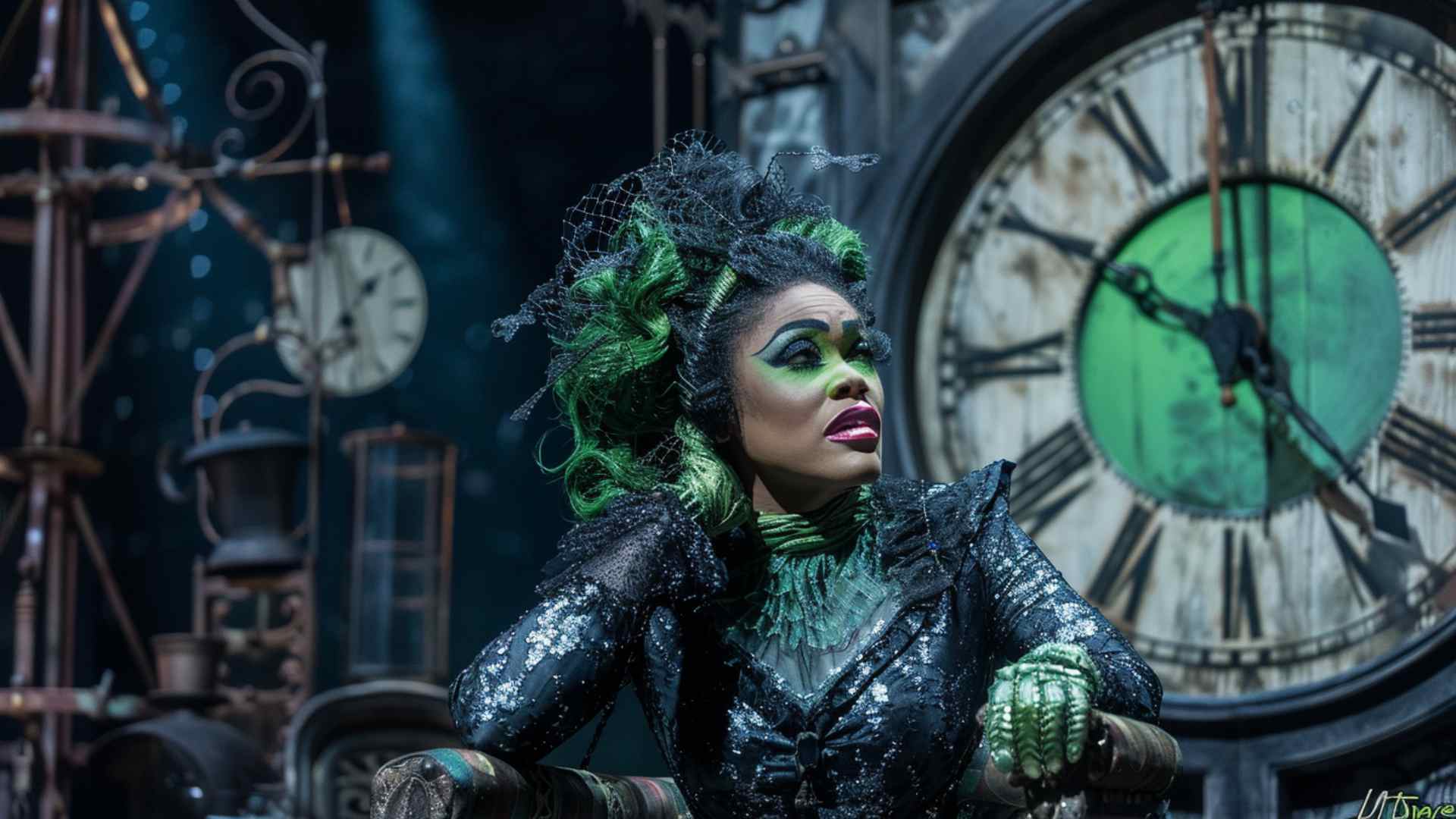
Q: Roughly how long does it take to apply Elphaba’s green makeup?
A: About 30–45 minutes.
Q: Which body areas are typically painted green?
A: Face, neck, and hands (exposed skin).
Q: How costume-heavy is Glinda’s track?
A: She has many quick changes—well over half a dozen.
Q: What’s a shorthand description for Emerald City fashion in the show?
A: Twisted couture—eccentric, asymmetrical, and jewel-toned.
Q: Which storm-charged scene unleashes lightning and thunder at Kiamo Ko?
A: “No Good Deed.”
Q: How are the monkeys’ wings presented?
A: Articulated packs/harnesses integrated with costumes.
Q: Why do the dragon’s eyes glow menacingly?
A: Internal lighting and effects.
Q: What does Elphaba’s hat come to symbolize over time?
A: A reclaimed identity—what began as mockery becomes her emblem.
Q: What keeps the Act I flight safe show after show?
A: Strict cueing and mechanical safety protocols.
Q: What moving elements help mark time transitions between scenes?
A: Rotating gears, pendulums, and clock hands.
Awards, Records, Tours & Cultural Impact
Q: How many Tony Awards did Wicked win in 2004?
A: Three.
Q: Which top Tony did Wicked famously lose?
A: Best Musical (to Avenue Q).
Q: Which leading lady won a Tony for Wicked?
A: Idina Menzel (Best Actress in a Musical).
Q: Which designer won a Tony for costume design?
A: Susan Hilferty.
Q: Which designer won a Tony for scenic design?
A: Eugene Lee.
Q: Which Grammy did Wicked collect for its album?
A: Best Musical Show Album.
Q: Box-office wise, where does Wicked stand historically on Broadway?
A: Among the top-grossing shows ever.
Q: In longevity, where does Wicked sit among Broadway runs?
A: In the top five longest-running musicals.
Q: What year did the West End production open?
A: 2006.
Q: At which London venue does it play?
A: The Apollo Victoria Theatre.
Q: Name a country with a long-running licensed production beyond the U.S./U.K.
A: Japan.
Q: What nickname was used for a major U.S. touring company?
A: The Emerald City Tour.
Q: Which city hosted a multi-year sit-down beginning in 2005?
A: Chicago.
Q: What Chicago venue presented that run?
A: The Oriental Theatre (now the Nederlander Theatre).
Q: Which Australian city launched the production in 2008?
A: Melbourne.
Q: Which major Japanese theater company has staged Wicked?
A: Shiki Theatre Company.
Q: Which German city hosted a 2007 production?
A: Stuttgart.
Q: What milestone did Broadway celebrate in 2023?
A: Its 20th anniversary.
Q: Which social platform helped revive mass interest in Wicked belting?
A: TikTok (viral “Defying Gravity” riffs).
Q: What 2022 announcement about the film adaptation surprised fans?
A: The story would be split into two movies.
Q: Who leads the film as Elphaba and Glinda?
A: Cynthia Erivo and Ariana Grande.

Ellie Ewert is the founder and author of RandomTrivia.co, blending her passion for research with years of experience in content creation to deliver accurate, engaging, and well-sourced trivia. Dedicated to providing readers with trustworthy and entertaining facts, she applies meticulous fact-checking and SEO expertise to ensure every article meets the highest standards. Read more about our high standards in our Editorial Guidelines.