
From sunny skies to superstorms, weather and climate shape daily life and the fate of ecosystems.
This mega set moves from basics and cloud types to hurricanes, El Niño, instruments, climate science, and jaw-dropping records.
Start easy, ramp up to expert, and enjoy the breeze of learning.
Weather Basics & the Atmosphere
Q: What’s the simple difference between weather and climate?
A: Weather is short-term conditions (hours to days); climate is long-term averages and variability (typically 30+ years).
Q: Which gas makes up most of Earth’s dry air?
A: Nitrogen, at about 78%, followed by oxygen at about 21%.
Q: In which atmospheric layer does almost all weather occur?
A: The troposphere.
Q: What does a “lapse rate” describe?
A: How temperature changes with height—usually decreasing with altitude in the troposphere.
Q: What term describes the temperature at which air becomes saturated?
A: The dew point.
Q: Why is the sky blue on a clear day?
A: Rayleigh scattering preferentially scatters shorter (blue) wavelengths of sunlight.
Q: What force, caused by Earth’s rotation, deflects moving air?
A: The Coriolis effect—rightward in the Northern Hemisphere, leftward in the Southern Hemisphere. NOAA.
Q: What does “albedo” measure?
A: The fraction of incoming sunlight a surface reflects; fresh snow has high albedo, oceans low.
Q: Name two major greenhouse gases besides water vapor.
A: Carbon dioxide and methane (others include nitrous oxide and ozone).
Q: Why does pressure generally decrease with height?
A: Because the weight of the overlying air column decreases as you go upward.
Clouds & Precipitation
Q: Which two cloud types are the classic “puffy” and “sheet” forms?
A: Cumulus (puffy) and stratus (layered).
Q: Which cloud type is tall and associated with thunderstorms?
A: Cumulonimbus.
Q: What suffix often indicates rain-bearing clouds?
A: “-nimbus,” as in nimbostratus and cumulonimbus.
Q: What’s drizzle compared to rain?
A: Drizzle has smaller, more numerous drops (≤0.5 mm), usually from low stratus; rain has larger drops.
Q: What name is given to rain that evaporates before reaching the ground?
A: Virga.
Q: Which process forms snowflakes in cold clouds: Bergeron or warm-rain?
A: The Bergeron (ice-crystal) process.
Q: What are mammatus clouds known for?
A: Pouch-like bulges under a cloud base, often associated with severe storms.
Q: What instrument do airports use to measure cloud base height?
A: A ceilometer.
Q: What is graupel?
A: Soft, small pellets formed when supercooled droplets freeze onto snowflakes.
Q: When warm moist air is forced uphill and clouds form, what is that lifting called?
A: Orographic lift.
Wind, Pressure & Fronts
Q: On a weather map, what do closely spaced isobars indicate?
A: A strong pressure gradient and typically stronger winds.
Q: What’s the sea breeze?
A: Daytime onshore wind caused by land heating faster than water, creating a local pressure difference.
Q: Which front often brings a quick temperature drop and showery weather?
A: A cold front.
Q: What’s an occluded front?
A: When a cold front overtakes a warm front, lifting warm air aloft and merging systems.
Q: What is geostrophic wind?
A: Upper-level flow where pressure-gradient force balances Coriolis, producing winds parallel to isobars.
Q: Name the narrow band of strong upper-level winds crucial for steering storms.
A: The jet stream.
Q: What do we call hot, dry downslope winds on a mountain’s lee side (e.g., Chinook, Föhn)?
A: Foehn-type winds—adiabatically warmed after losing moisture on the windward slope.
Q: What’s the nighttime downslope flow of cold dense air called?
A: A katabatic wind.
Q: Why does surface wind usually cross isobars toward lower pressure?
A: Friction weakens Coriolis, allowing a component toward the pressure gradient.
Q: What is a baroclinic zone?
A: A region with strong temperature gradients that fuels mid-latitude cyclones.
Severe Storms: Thunderstorms, Hail & Tornadoes
Q: What three ingredients are classic for thunderstorm formation?
A: Moisture, instability (CAPE), and lift (like fronts or terrain).
Q: What is lightning’s immediate acoustic result?
A: Thunder—the sound of rapidly expanding, heated air.
Q: What’s a microburst?
A: A small, intense downdraft producing damaging straight-line winds near the surface.
Q: What role does vertical wind shear play in severe storms?
A: It organizes storms, supporting supercells and long-lived systems.
Q: What is a mesocyclone?
A: A rotating updraft within a supercell thunderstorm.
Q: Where in a supercell is large hail most likely?
A: In or near the right-rear flank, where updraft cycles hail through growth regions.
Q: What’s the difference between a tornado watch and a warning?
A: Watch: conditions are favorable; Warning: a tornado is occurring or indicated by radar.
Q: What is a hook echo on radar?
A: A curved reflectivity signature often associated with a supercell’s rotating updraft.
Q: Define a derecho.
A: A long-lived, widespread windstorm linked to a fast-moving line of severe thunderstorms.
Q: Why is the rear-flank downdraft (RFD) important in tornado genesis?
A: Its thermodynamic and momentum structure can help focus rotation near the ground.
Tropical Cyclones: Hurricanes, Typhoons & Cyclones
Q: What’s the generic term for hurricanes and typhoons?
A: Tropical cyclones (names vary by basin).
Q: What ocean temperatures typically support development?
A: Warm sea surface temperatures, commonly cited as about 26–27°C (79–81°F) or higher.
Q: Which scale classifies Atlantic hurricane intensity?
A: The Saffir–Simpson Hurricane Wind Scale (Category 1–5 by 1-minute sustained winds).
Q: What is the cyclone’s calm center called?
A: The eye, surrounded by the eyewall of intense convection.
Q: What hazard causes the most coastal deaths in many landfalls?
A: Storm surge—abnormal sea-level rise driven by wind and pressure.
Q: What is an eyewall replacement cycle?
A: When a new outer eyewall forms and contracts, often weakening then restrengthening the storm.
Q: Why are tropical cyclones rare right at the Equator?
A: Coriolis force is near zero, limiting rotation development.
Q: What typically increases vertical wind shear in the Atlantic during El Niño?
A: Strengthened upper-level westerlies over the tropical Atlantic, which can suppress hurricanes.
Q: What is extratropical transition?
A: When a tropical cyclone becomes asymmetric and gains fronts, turning into a mid-latitude cyclone.
Q: In the Northern Hemisphere, which quadrant is often the “dangerous” side?
A: The right-front quadrant relative to motion, where surge and winds can maximize.
Oceans, Teleconnections & Monsoons
Q: What does ENSO stand for?
A: El Niño–Southern Oscillation, a coupled ocean-atmosphere pattern in the tropical Pacific.
Q: During El Niño, which part of the Pacific tends to warm at the surface?
A: The central and/or eastern tropical Pacific.
Q: What is La Niña?
A: The cool phase of ENSO, with stronger trade winds and enhanced upwelling in the eastern Pacific.
Q: What is upwelling?
A: The rise of cold, nutrient-rich water to the surface, often driven by wind patterns and Ekman transport.
Q: What circulation links Pacific trade winds with rising motion in the west and sinking in the east?
A: The Walker circulation.
Q: Name one other teleconnection besides ENSO.
A: The North Atlantic Oscillation (NAO), Pacific Decadal Oscillation (PDO), Indian Ocean Dipole (IOD), or Madden–Julian Oscillation (MJO).
Q: What is the MJO famous for modulating?
A: Intraseasonal (30–60 day) convective bursts that can influence rainfall and cyclone activity.
Q: What drives the South Asian monsoon?
A: Land–sea thermal contrasts and seasonal reversal of winds, enhanced by plateau heating and moisture transport.
Q: How can El Niño affect global rainfall patterns?
A: It shifts convection and jet streams, often bringing wetter conditions to some regions and drought to others.
Q: Why do eastern ocean basin coasts often have cold currents and fog?
A: Upwelling and cold boundary currents cool marine layers, promoting stratus and advection fog.

Climate Zones & Climate Science
Q: What system commonly classifies world climates with letters like “Af,” “Csa,” or “Dfb”?
A: The Köppen–Geiger climate classification.
Q: What does “Mediterranean climate” mean in Köppen terms?
A: Dry summer, wet winter (e.g., Csa or Csb).
Q: How does altitude affect climate?
A: Higher elevations are generally cooler and can be wetter on windward slopes.
Q: What are biomes?
A: Broad ecological communities (like tundra, desert, rainforest) shaped by climate.
Q: Name one proxy used to reconstruct past climates.
A: Ice cores, tree rings, corals, sediment layers, or speleothems.
Q: What are Milankovitch cycles?
A: Long-term variations in Earth’s orbit and tilt that influence glacial–interglacial cycles.
Q: Define radiative forcing.
A: The change in Earth’s energy balance (W/m²) due to drivers like greenhouse gases or aerosols.
Q: What is equilibrium climate sensitivity often estimated to be?
A: Around 3°C (with a likely range) of global warming for a doubling of CO₂, based on multiple lines of evidence.
Q: Why do aerosols sometimes cool climate regionally?
A: They reflect sunlight and can modify clouds, increasing albedo.
Q: What’s the difference between mitigation and adaptation?
A: Mitigation reduces the causes of climate change; adaptation manages its impacts.
Weather Instruments & Forecasting
Q: What instrument measures atmospheric pressure?
A: A barometer (mercury or aneroid types).
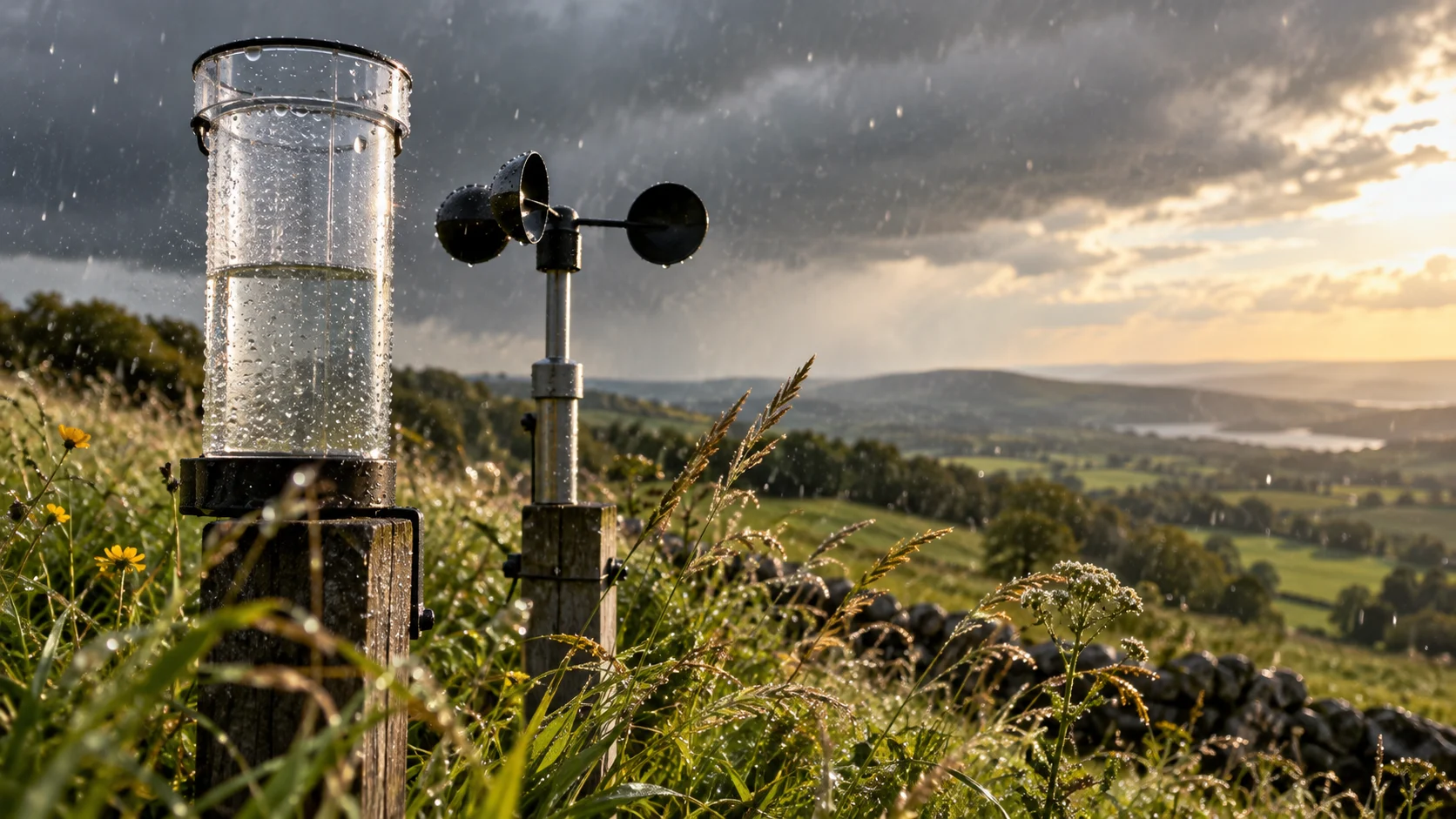
Q: What does an anemometer measure?
A: Wind speed (and sometimes direction with a vane).
Q: What is a radiosonde?
A: A weather balloon payload measuring temperature, humidity, and pressure as it ascends.
Q: How does Doppler radar help forecasters beyond locating rain?
A: It measures radial velocity, revealing rotation, wind shear, and microbursts.
Q: What’s the main difference between geostationary and polar-orbiting weather satellites?
A: Geostationary stay fixed over one longitude; polar orbiters scan the whole Earth in swaths.
Q: What do METAR and TAF stand for in aviation weather?
A: METAR: routine weather report; TAF: terminal aerodrome forecast.
Q: Name two global numerical weather models.
A: Examples include ECMWF and GFS (among others like UKMET, ICON).
Q: What is data assimilation?
A: The process of blending observations with model output to create the best estimate of the atmosphere.
Q: Why do forecast “cones” for tropical cyclones expand with lead time?
A: Uncertainty grows with time; the cone reflects historical track errors at each forecast horizon.
Q: What’s ensemble forecasting?
A: Running models many times with slight differences to sample uncertainty and provide probabilistic guidance.
Human Impacts, Urban Weather & Health
Q: What is the urban heat island?
A: Cities are warmer—especially at night—due to heat-retaining materials and reduced vegetation.
Q: Why do trees cool neighborhoods beyond shade alone?
A: Evapotranspiration removes heat as water changes phase, lowering air temperature.
Q: What simple building strategy reduces cooling loads in hot climates?
A: High-albedo (cool) roofs that reflect more sunlight.
Q: How can air pollution influence fog and clouds?
A: Aerosols act as cloud condensation nuclei, altering droplet numbers and visibility.
Q: Why are heat waves especially dangerous in humid climates?
A: High humidity limits sweat evaporation, hindering the body’s cooling.
Q: What is a wet-bulb temperature?
A: The lowest temperature attainable by evaporating water; a measure tied to heat stress limits.
Q: What is the “Great Smog” of London (1952) known for?
A: A severe smog episode from cold, stagnant air and coal smoke that caused thousands of deaths.
Q: Name one way green infrastructure can reduce urban flooding.
A: Permeable pavements, rain gardens, or green roofs increase infiltration and storage.
Q: How can drought raise urban air temperatures?
A: Dry soils reduce evaporative cooling, allowing more sensible heat to warm the air.
Q: What’s one health co-benefit of reducing fossil-fuel emissions besides climate gains?
A: Improved air quality, cutting respiratory and cardiovascular risks.
Aviation, Marine & Mountain Weather
Q: Why does icing worry pilots?
A: Ice disrupts airflow, increases drag, and reduces lift, impairing performance.
Q: What cloud/terrain setup can cause dangerous mountain wave turbulence?
A: Strong cross-barrier flow with stable layers, producing standing waves and rotors downwind.
Q: What is wind shear on takeoff and landing?
A: Sudden changes in wind speed/direction with height that can rapidly alter aircraft airspeed.
Q: What is a marine layer?
A: A shallow, cool, moist layer capped by a temperature inversion—common along cold coasts.
Q: Why can sea fog persist even under sun?
A: The cool ocean keeps air near dew point; weak mixing preserves fog.
Q: What are katabatic winds common in polar regions?
A: Gravity-driven downslope flows of very cold, dense air off ice sheets.
Q: What phenomenon creates “gap winds” in straits and mountain passes?
A: Pressure differences accelerate air through narrow terrain, funneling strong winds.
Q: Why is density altitude critical for aircraft?
A: High density altitude (hot, high, humid) reduces engine power and lift, lengthening takeoff distance.
Q: What is lee cyclogenesis?
A: Cyclone formation on a mountain range’s downwind side due to stretching and vorticity generation.
Q: What’s a fetch in marine forecasting?
A: The distance over water that wind blows, controlling wave growth and swell.
Extremes, Records & Historic Events
Q: What location holds the WMO-recognized highest air temperature record?
A: Furnace Creek (Death Valley), California, at 56.7°C (134°F) in 1913, as recognized by the WMO.
Q: Where was the lowest reliably measured surface air temperature on Earth?
A: Vostok Station, Antarctica, at −89.2°C (−128.6°F) in 1983.
Q: Which region is often cited as one of the driest places on Earth?
A: The Atacama Desert in Chile, where some sites record virtually no rain for decades.
Q: What’s the 24-hour global rainfall record location often referenced?
A: Foc-Foc, La Réunion, which received extraordinary rainfall during a tropical cyclone in 1966.
Q: Which tropical cyclone holds the record for lowest central pressure globally?
A: Typhoon Tip (1979), with a central pressure around 870 hPa.
Q: What volcanic eruption in 1991 temporarily cooled global temperatures?
A: Mount Pinatubo; sulfate aerosols increased reflection of sunlight for a year or two.
Q: Which 1950s event spotlighted deadly air pollution in the UK?
A: The Great Smog of London in December 1952.
Q: Which 1970 storm in the Bay of Bengal is often cited as the deadliest tropical cyclone?
A: The Bhola cyclone, with several hundred thousand fatalities reported.
Q: What U.S. event in the 1930s highlighted land management and climate impacts?
A: The Dust Bowl, with severe drought, heat, and dust storms across the Great Plains.
Q: Which island is famed for extreme orographic rainfall totals from passing cyclones?
A: La Réunion in the southwest Indian Ocean.

Ellie Simons creates and edits Random Trivia. She researches trivia using primary and authoritative sources whenever possible and is currently reviewing the site's older trivia library for accuracy, clarity, and playability. Read more on the About page.
Explore more questions in our geography trivia guide.
About this quiz
Site editor: Ellie Simons. Read our Trivia Methodology to learn how questions are researched and updated. Page last updated: . Report an error.