
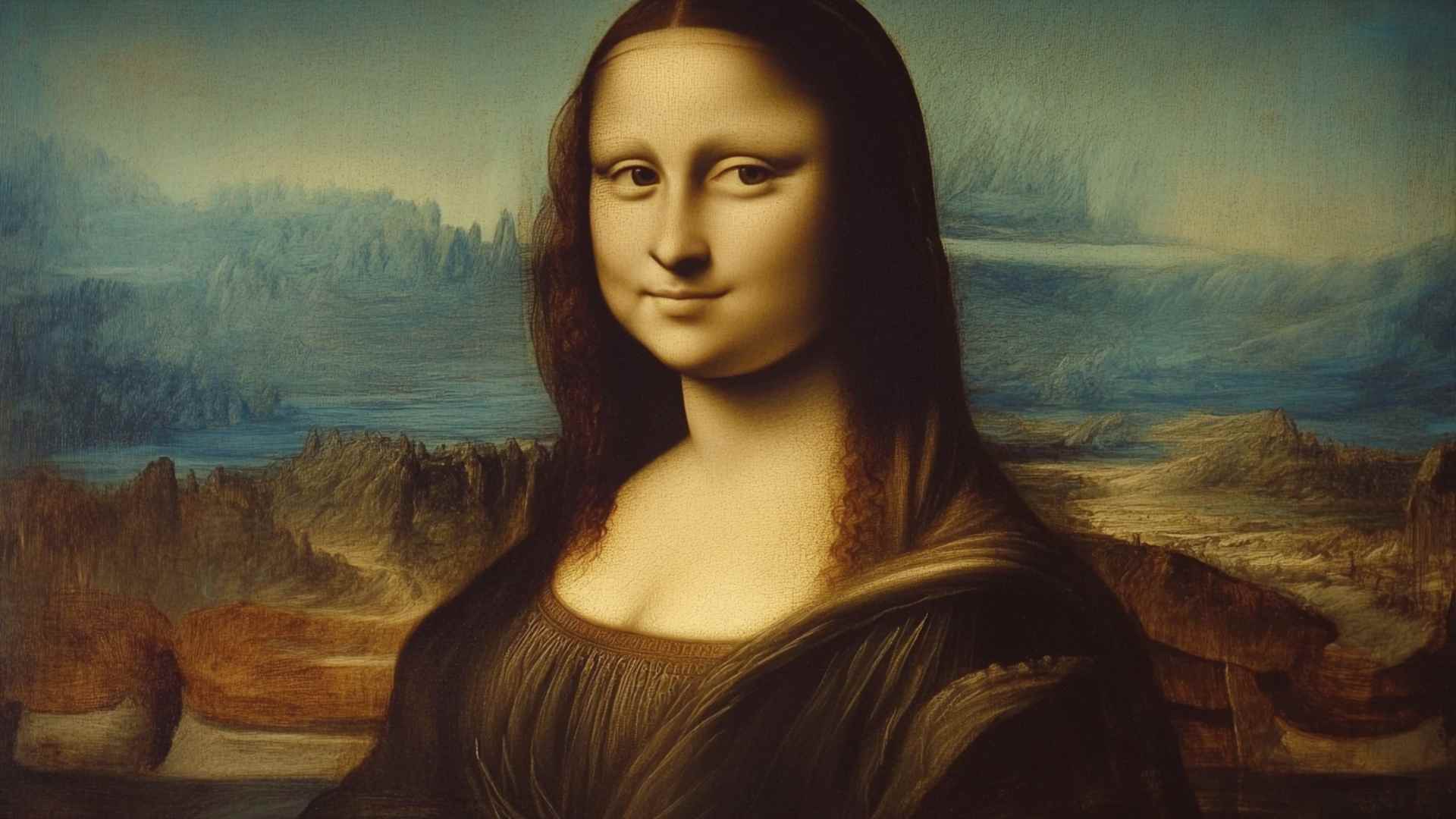
From the Mona Lisa’s enigmatic smile to Pop Art’s punchy icons, this mega-pack of art trivia spans centuries, styles, and cultures.
Work from gentle warm-ups to trickier nuggets across eight themed categories, each with 21 questions and answers.
Perfect for pub nights, classrooms, or anyone who loves famous paintings and art history.
Why Famous Paintings Make Great Trivia
Paintings are time capsules: they reveal how artists observed their world, experimented with materials, and responded to politics, science, and belief.
Because canonical works are so recognizable, yet brimming with details, painting trivia effortlessly balances accessibility with depth.
Art history also stretches far beyond Europe.
From Persian miniatures to Japanese ukiyo-e to Aboriginal desert painting, global perspectives enrich the conversation and make trivia more inclusive, surprising, and fun.
Renaissance & Early Masters
Q: Who painted the “Mona Lisa”?
A: Leonardo da Vinci.
Q: In what city can you look up to Michelangelo’s ceiling masterpieces?
A: Vatican City (Sistine Chapel).
Q: What soft, smoky blending technique is a Leonardo trademark?
A: Sfumato.
Q: What medium did Michelangelo use on the Sistine Chapel ceiling?
A: Buon fresco.
Q: Which Botticelli painting shows a goddess arriving on a shell?
A: “The Birth of Venus.”
Q: Which mural depicts Christ announcing a betrayal to the Twelve?
A: “The Last Supper.”
Q: What is the title of Raphael’s fresco of ancient philosophers?
A: “The School of Athens.”
Q: Who demonstrated linear perspective with famous experiments in Florence?
A: Filippo Brunelleschi.
Q: Which proto-Renaissance master frescoed the Arena (Scrovegni) Chapel?
A: Giotto di Bondone.
Q: What’s the name of Leonardo’s drawing of a man in a circle and square?
A: “Vitruvian Man.”
Q: Which 1434 double portrait is famed for a convex mirror and oranges?
A: Jan van Eyck’s “Arnolfini Portrait.”
Q: What binder supplanted egg tempera in Northern Renaissance painting?
A: Linseed oil (oil painting).
Q: Who painted “Primavera”?
A: Sandro Botticelli.
Q: Which city nurtured color-rich painting by Titian and Giorgione?
A: Venice.
Q: Who painted the radically foreshortened “Lamentation of Christ” (Dead Christ)?
A: Andrea Mantegna.
Q: What experimental medium caused “The Last Supper” to deteriorate?
A: Tempera and oil on dry plaster (not true fresco).
Q: Which High Renaissance star died in 1520 at age 37?
A: Raphael.
Q: Titian’s mythologies for Philip II of Spain are collectively called what?
A: The “Poesie.”
Q: Piero della Francesca advanced painting using what underlying discipline?
A: Geometry/perspective mathematics.
Q: Who is generally credited with the “Mérode Altarpiece”?
A: Workshop of Robert Campin (Master of Flémalle).
Q: Where is Bosch’s triptych “The Garden of Earthly Delights” housed?
A: Museo del Prado, Madrid.

Baroque & Rococo Highlights
Q: Who painted the dynamic militia scene nicknamed “The Night Watch”?
A: Rembrandt van Rijn.
Q: What is Velázquez’s enigmatic court portrait with a painter at his easel?
A: “Las Meninas.”
Q: Caravaggio’s dramatic spotlighting is best known by what term?
A: Tenebrism (heightened chiaroscuro).
Q: Who painted “The Calling of Saint Matthew” in Rome’s San Luigi dei Francesi?
A: Caravaggio.
Q: Which painter depicted Judith beheading Holofernes with vivid realism?
A: Artemisia Gentileschi.
Q: Peter Paul Rubens led a flourishing studio in which city?
A: Antwerp.
Q: Which Dutch master specialized in intimate domestic interiors like “The Milkmaid”?
A: Johannes Vermeer.
Q: “Girl with a Pearl Earring” is in which museum?
A: The Mauritshuis, The Hague.
Q: Rembrandt revolutionized which printmaking medium?
A: Etching.
Q: Whose frothy Rococo canvas is simply called “The Swing”?
A: Jean-Honoré Fragonard.
Q: Watteau popularized elegant outdoor amusements known as what?
A: Fête galante.
Q: Which French painter repeatedly portrayed Madame de Pompadour?
A: François Boucher.
Q: Who painted the Neoclassical “Oath of the Horatii”?
A: Jacques-Louis David.
Q: David memorialized which revolutionary in his bath?
A: Jean-Paul Marat (“The Death of Marat”).
Q: Which 1814 Ingres canvas lengthens anatomy for exotic allure?
A: “La Grande Odalisque.”
Q: What rare blue pigment gives Vermeer’s canvases their glow?
A: Natural ultramarine (from lapis lazuli).
Q: What optical device is often said to have influenced “Las Meninas”?
A: The camera obscura (hypothesized).
Q: Which upheaval helped end Rococo’s frivolity?
A: The French Revolution.
Q: A major 1659 Rembrandt “Self-Portrait” hangs in which U.S. museum?
A: The National Gallery of Art, Washington, D.C.
Q: Why did Caravaggio flee Rome in 1606?
A: He killed a man in a brawl.
Q: Which Neoclassical master championed line over color, opposing Romantic excess?
A: Jean-Auguste-Dominique Ingres.
Romanticism & Realism
Q: Who painted the barricade-waving “Liberty Leading the People”?
A: Eugène Delacroix.
Q: Goya’s “The Third of May 1808” commemorates what atrocity?
A: Napoleonic troops executing Spanish civilians.
Q: Turner’s elegy to a ship tugged to scrap is titled what?
A: “The Fighting Temeraire.”
Q: Which German canvas shows a lone figure surveying misty peaks?
A: Caspar David Friedrich’s “Wanderer above the Sea of Fog.”
Q: Géricault’s giant painting of shipwreck survivors is called?
A: “The Raft of the Medusa.”
Q: Which Realist painted laborers in “The Stone Breakers”?
A: Gustave Courbet.
Q: Courbet’s vast funeral scene bears what title?
A: “A Burial at Ornans.”
Q: Which Millet painting focuses on poor women gleaning leftover grain?
A: “The Gleaners.”
Q: Honoré Daumier’s political prints chiefly used which process?
A: Lithography.
Q: Thomas Cole founded which American landscape movement?
A: The Hudson River School.
Q: What was the central debate between Ingres and Delacroix?
A: Line (Ingres) versus color (Delacroix).
Q: Romantic artists seeking the sublime often emphasized what forces?
A: Awe-inspiring, dangerous nature.
Q: Rosa Bonheur became famous for painting what subjects?
A: Animals—especially horses and cattle.
Q: What did Courbet open in 1855 to defy the official Exposition?
A: The Pavilion of Realism (Pavillon du Réalisme).
Q: What architectural motif in ruins haunts many Friedrich works?
A: Gothic churches/abbeys.
Q: What name is given to Goya’s dark, late wall paintings?
A: The Black Paintings.
Q: Critics hailed Turner as a painter of what element?
A: Light.
Q: Which colorist of the past did Delacroix especially admire?
A: Peter Paul Rubens.
Q: Courbet’s 1855 studio canvas carries what long subtitle?
A: “A real allegory summing up seven years of my artistic life.”
Q: Which poet-critic championed modernity and supported Manet?
A: Charles Baudelaire.
Q: The Barbizon School painted near which forest?
A: The Forest of Fontainebleau.

Impressionism & Post-Impressionism
Q: Which 1872 Monet canvas gave Impressionism its name?
A: “Impression, Sunrise.”
Q: Where are Monet’s giant “Water Lilies” panoramas permanently installed?
A: Musée de l’Orangerie, Paris.
Q: Which 1863 Manet picnic scandalized Paris?
A: “Le Déjeuner sur l’herbe.”
Q: Degas’s favorite performing-arts subject was what?
A: Ballet dancers.
Q: Renoir’s joyous 1876 Montmartre scene is titled?
A: “Bal du moulin de la Galette.”
Q: Who painted “Paris Street; Rainy Day,” capturing Haussmann’s new boulevards?
A: Gustave Caillebotte.
Q: Which Impressionist focused on mothers and children, often in the domestic sphere?
A: Mary Cassatt.
Q: Why is Camille Pissarro called the “dean” of Impressionism?
A: He mentored others and exhibited in all eight Impressionist shows.
Q: Seurat’s dot method is known as what?
A: Pointillism (Divisionism).
Q: Where can you see Seurat’s island scene of Sunday strollers?
A: Art Institute of Chicago.
Q: Where did Van Gogh paint “The Starry Night”?
A: At Saint-Paul-de-Mausole asylum in Saint-Rémy.
Q: Which complementary pair did Van Gogh often intensify for vibrancy?
A: Blue and orange.
Q: Gauguin left Paris seeking “the primitive” on which island?
A: Tahiti.
Q: Cézanne’s methodical brushwork is often called what?
A: Constructive strokes.
Q: Which mountain dominates Cézanne’s Provence views?
A: Mont Sainte-Victoire.
Q: Toulouse-Lautrec’s posters promoted which cabaret?
A: The Moulin Rouge.
Q: Who obsessively painted haystacks, poplars, cathedrals, and water gardens?
A: Claude Monet.
Q: Van Gogh’s 1888 series of radiant yellow blooms is titled?
A: “Sunflowers.”
Q: Paul Signac’s key theoretical writing promoted which approach?
A: Neo-Impressionism/Divisionism.
Q: What unusual viewpoints did Degas favor in compositions?
A: Cropped, off-center, or high vantage points.
Q: Which museum houses Manet’s “Olympia”?
A: Musée d’Orsay, Paris.
Early Modernism: Fauvism, Cubism & Expressionism
Q: Which 1905 “wild beasts” leader shocked Paris with blazing color?
A: Henri Matisse.
Q: Why did “Woman with a Hat” scandalize critics?
A: Non-naturalistic, arbitrary color.
Q: What 1907 Picasso canvas helped launch Cubism?
A: “Les Demoiselles d’Avignon.”
Q: Who co-created Analytic Cubism with Picasso?
A: Georges Braque.
Q: What Cubist idea shows objects from several angles at once?
A: Fractured, multiple viewpoints (Analytic Cubism).
Q: Which German group included Kirchner and Heckel?
A: Die Brücke (The Bridge).
Q: Which Blue Rider pioneer painted “Composition VII”?
A: Wassily Kandinsky.
Q: Which painting scandalized the 1913 Armory Show?
A: Duchamp’s “Nude Descending a Staircase, No. 2.”
Q: Mondrian’s grids and primaries belong to what movement?
A: De Stijl (Neoplasticism).
Q: “Black Square” (1915) epitomizes which Russian avant-garde?
A: Suprematism (Kazimir Malevich).
Q: What did Futurists celebrate in manifestos and canvases?
A: Speed, machines, modernity.
Q: Severini and Boccioni were leaders in which country’s avant-garde?
A: Italy (Futurism).
Q: Who painted expressive “Blue Horse” works?
A: Franz Marc.
Q: What collage method introduced real paper into paintings?
A: Papier collé.
Q: What did Juan Gris contribute to Cubism’s evolution?
A: Structured clarity of Synthetic Cubism.
Q: Name a monumental Matisse cut-out.
A: “The Snail.”
Q: Modigliani portraits are known for what stylization?
A: Elongated necks and almond eyes.
Q: Egon Schiele is associated with which movement circle?
A: Viennese Expressionism (Vienna Secession).
Q: Where did Paul Klee teach while “taking a line for a walk”?
A: The Bauhaus.
Q: Which Spaniard shifted from his Blue Period to Cubism?
A: Pablo Picasso.
Q: What 1913 event introduced European modernism to America?
A: The Armory Show.

Surrealism to Abstract Expressionism
Q: The melting clocks belong to which painting?
A: Dalí’s “The Persistence of Memory.”
Q: What paradoxical line appears on Magritte’s pipe picture?
A: “Ceci n’est pas une pipe.”
Q: What method of automatic creation tapped the unconscious?
A: Automatism.
Q: Miró’s playful biomorphs often resemble what?
A: Dreamlike constellations/creatures.
Q: What rubbing technique did Max Ernst pioneer?
A: Frottage.
Q: Which Mexican artist painted “The Two Fridas”?
A: Frida Kahlo.
Q: Giorgio de Chirico’s eerie plazas exemplify what style?
A: Metaphysical painting.
Q: Which American-Armenian bridged Surrealism and Abstract Expressionism?
A: Arshile Gorky.
Q: What kinetic technique defined Jackson Pollock’s canvases?
A: Drip painting/action painting.
Q: Which city became the post-WWII art center?
A: New York.
Q: What do Rothko’s glowing rectangles aim to evoke?
A: Profound, meditative emotion.
Q: What subject headlines de Kooning’s ferocious 1950s series?
A: “Woman” paintings.
Q: Which 1952 stain painting signaled Color Field abstraction?
A: Helen Frankenthaler’s “Mountains and Sea.”
Q: Barnett Newman’s vertical bands are called what?
A: Zips.
Q: Motherwell’s “Elegies” mourn which conflict?
A: The Spanish Civil War.
Q: Clyfford Still’s jagged fields belong to what tendency?
A: Color Field/Abstract Expressionism.
Q: From which country did Leonora Carrington originally hail?
A: Britain (England).
Q: Within Surrealism, who served as chief theorist?
A: André Breton.
Q: Which gallery owner backed Pollock in 1940s New York?
A: Peggy Guggenheim (Art of This Century).
Q: Which magazine nicknamed Pollock “Jack the Dripper”?
A: Time magazine.
Q: Name a landmark Gorky canvas blending surreal biomorphs and abstraction.
A: “The Liver Is the Cock’s Comb.”
American Art & Pop Culture
Q: Who painted the pitchfork-paired “American Gothic”?
A: Grant Wood.
Q: What’s Edward Hopper’s famous late-night diner scene?
A: “Nighthawks.”
Q: Georgia O’Keeffe’s monumental close-ups typically depict what?
A: Flowers (and desert forms).
Q: Jacob Lawrence’s 60-panel series chronicles what movement?
A: The Great Migration.
Q: What is Norman Rockwell’s 1964 civil-rights painting featuring Ruby Bridges?
A: “The Problem We All Live With.”
Q: What photo-based process powered Warhol’s celebrity images?
A: Screenprinting (silkscreen).
Q: Name Warhol’s 1962 pantry-aisle icon set of 32 canvases.
A: “Campbell’s Soup Cans.”
Q: What signature device defines Lichtenstein’s comic-inspired paintings?
A: Ben-Day dots (with speech bubbles).
Q: Which artist made the “Marilyn Diptych” (1962)?
A: Andy Warhol.
Q: What billboard-scale painting by James Rosenquist wraps the viewer?
A: “F-111.”
Q: Which 1980s painter fused crowns, text, and street energy?
A: Jean-Michel Basquiat.
Q: Keith Haring’s figures are rendered in what hallmark style?
A: Bold, radiant line drawings.
Q: Kehinde Wiley painted the official portrait of which U.S. president?
A: Barack Obama.
Q: Alma Thomas’s canvases feature what distinctive mark-making?
A: Bright, mosaic-like dabs/stripes.
Q: Faith Ringgold is renowned for which hybrid practice?
A: Story quilts (painted quilts).
Q: Barkley L. Hendricks revitalized which genre with cool realism?
A: Portraiture.
Q: Kerry James Marshall’s work centers on what theme?
A: Black life and representation in art history.
Q: Wayne Thiebaud famously painted luscious arrays of what?
A: Cakes, pies, and desserts.
Q: Who used encaustic to paint American flags and targets?
A: Jasper Johns.
Q: Robert Rauschenberg’s painting-sculpture hybrids are called what?
A: Combines.
Q: Which painting sparked a major debate at the 2017 Whitney Biennial?
A: Dana Schutz’s “Open Casket.”
Global Perspectives: Asia, Islamic, Africa & Latin America
Q: Which Japanese print of a towering breaker is world-famous?
A: Hokusai’s “The Great Wave off Kanagawa.”
Q: Ukiyo-e prints commonly depicted which urban entertainments?
A: Kabuki actors, courtesans, and city pleasures—plus landscapes.
Q: Hiroshige is best known for which travel series?
A: “The Fifty-Three Stations of the Tōkaidō.”
Q: Traditional Chinese landscape painting typically uses what materials?
A: Ink and wash on silk or paper.
Q: Which monumental Northern Song masterpiece is by Fan Kuan?
A: “Travelers Among Mountains and Streams.”
Q: The handscroll “Along the River During the Qingming Festival” records life in which capital?
A: Bianjing (Kaifeng), Northern Song.
Q: Who painted the Mughal miniature “Jahangir Preferring a Sufi Shaikh to Kings”?
A: Bichitr.
Q: The Persian master Behzad excelled in what genre?
A: Illuminated miniature painting.
Q: In sacred contexts, Islamic art often favors what visual elements?
A: Geometric patterns and calligraphy over figural imagery.
Q: Ethiopian Christian icons are noted for what facial trait?
A: Frontal figures with large, almond eyes.
Q: Which Nigerian artist painted the famed portrait nicknamed “Tutu”?
A: Ben Enwonwu.
Q: Which Brazilian modernist painted the anthropophagic symbol “Abaporu”?
A: Tarsila do Amaral.
Q: Diego Rivera’s murals frequently celebrate what themes?
A: Labor, industry, and social history.
Q: Which Ecuadorian painter is known for anguished heads and hands?
A: Oswaldo Guayasamín.
Q: What name describes Fernando Botero’s voluminous figure style?
A: Boterismo.
Q: Australian Aboriginal dot painting encodes what kind of knowledge?
A: Dreaming stories/Songlines tied to Country.
Q: Emily Kame Kngwarreye was a leading artist of which tradition?
A: Anmatyerre/Aboriginal desert painting (Utopia community).
Q: Which Ghanaian-born artist creates shimmering bottle-cap wall works?
A: El Anatsui.
Q: Japan’s Gutai group promoted what approach to paint?
A: Bodily performance and radical material experimentation.
Q: Zhang Daqian revived which expressive landscape technique later in life?
A: Splash ink/splash color (“po mo”).
Q: Who led India’s Bengal School with lyrical wash paintings?
A: Abanindranath Tagore.

Ellie Simons creates and edits Random Trivia. She researches trivia using primary and authoritative sources whenever possible and is currently reviewing the site's older trivia library for accuracy, clarity, and playability. Read more on the About page.
About this quiz
Site editor: Ellie Simons. Read our Trivia Methodology to learn how questions are researched and updated. Page last updated: . Report an error.