
Ireland trivia can go wrong before question one if the island and the republic get treated as the same thing. I sorted that out first, then followed the Shannon through ancient tombs, independence, soda bread, ghost stories, Nobel winners, hurling, and rock music.
Island, Republic, Counties & Landscapes
Q: What is the capital of Ireland?
A: Dublin.
Q: What is Ireland’s official constitutional name?
A: Ireland, or Éire in Irish.
Q: What term helps distinguish the sovereign state from the whole island?
A: The Republic of Ireland.
Q: Which part of the island remains in the United Kingdom?
A: Northern Ireland.
Q: What is the capital of Northern Ireland?
A: Belfast.
Q: How many traditional counties are on the island of Ireland?
A: Thirty-two.
Q: How many traditional counties are in the Republic of Ireland?
A: Twenty-six.
Q: How many traditional counties are in Northern Ireland?
A: Six.
Q: What four historic provinces divide Ireland?
A: Leinster, Munster, Connacht, and Ulster.
Q: How many counties of historic Ulster lie in the Republic of Ireland?
A: Three.
Q: Which ocean lies west of Ireland?
A: The Atlantic Ocean.
Q: Which sea separates Ireland from Great Britain?
A: The Irish Sea.
Q: What channel lies between northeastern Ireland and Scotland?
A: The North Channel.
Q: What is the longest river in Ireland?
A: The River Shannon.
Q: What is the largest lake on the island of Ireland?
A: Lough Neagh.
Q: In which jurisdiction is Lough Neagh?
A: Northern Ireland.
Q: What is the highest mountain in Ireland?
A: Carrauntoohil.
Q: In which county is Carrauntoohil?
A: County Kerry.
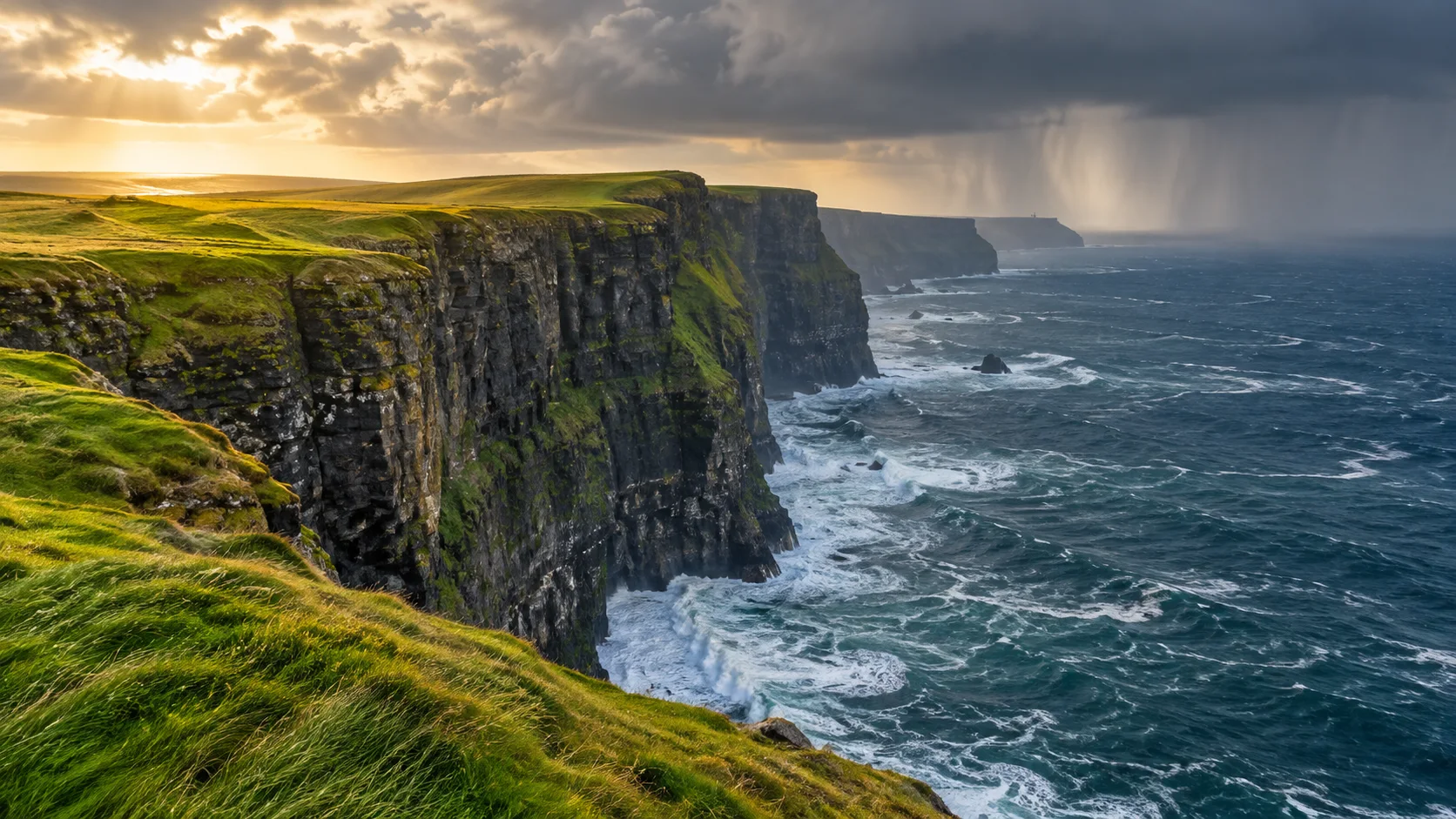
Q: What dramatic sea cliffs rise in County Clare?
A: The Cliffs of Moher.
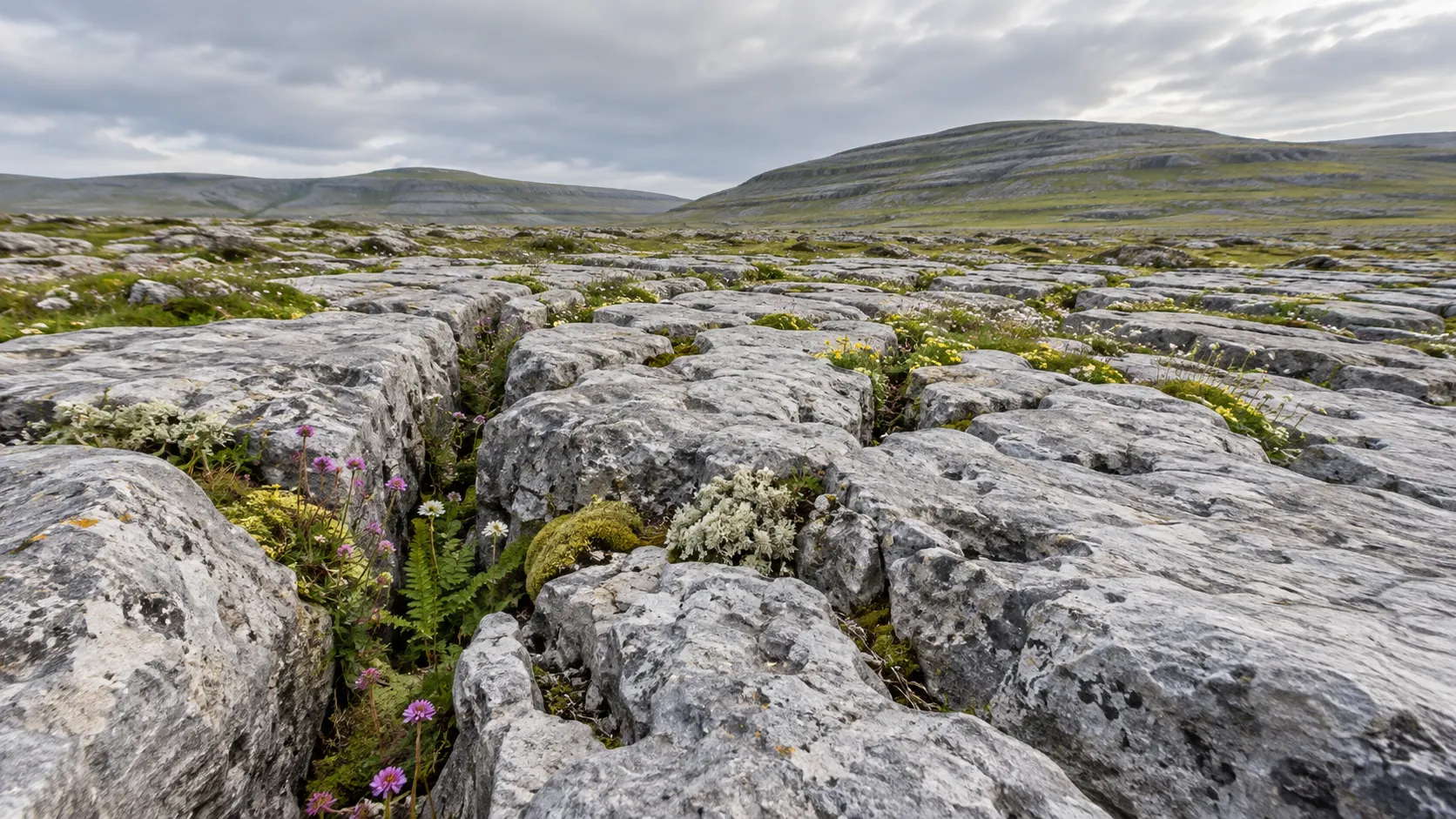
Q: What limestone landscape covers much of northwestern County Clare?
A: The Burren.
Q: What scenic route circles the Iveragh Peninsula?
A: The Ring of Kerry.
Q: What national park contains the Lakes of Killarney?
A: Killarney National Park.
Q: What group of mountains lies south of Dublin?
A: The Wicklow Mountains.
Q: What is Ireland’s largest county by area?
A: County Cork.
Q: Which county is nicknamed the Rebel County?
A: County Cork.
Q: Which county is nicknamed the Garden of Ireland?
A: County Wicklow.
Q: Which western city is known for its arts festivals and Atlantic setting?
A: Galway.
Q: Which southern city stands on the River Lee?
A: Cork.
Q: Which city is associated with King John’s Castle on the Shannon?
A: Limerick.
Q: What gulf current helps keep Ireland’s climate relatively mild?
A: The North Atlantic Drift.
Ancient Ireland, English Rule, Independence & Peace
Q: What prehistoric passage tomb is older than Stonehenge and the Egyptian pyramids?
A: Newgrange.
Q: In which archaeological complex is Newgrange located?
A: Brú na Bóinne.
Q: What event illuminates Newgrange’s inner chamber?
A: Sunrise around the winter solstice.
Q: Which Celtic language was historically dominant in Ireland?
A: Irish.
Q: What early medieval art style flourished in illuminated manuscripts and metalwork?
A: Insular art.
Q: Which illuminated manuscript is displayed at Trinity College Dublin?
A: The Book of Kells.
Q: Who is traditionally credited with spreading Christianity in fifth-century Ireland?
A: Saint Patrick.
Q: What monastic site was founded by Saint Kevin?
A: Glendalough.
Q: What seafaring raiders founded or expanded towns including Dublin and Waterford?
A: Vikings.
Q: What year is associated with the beginning of the Anglo-Norman invasion of Ireland?
A: 1169.
Q: Which English king followed the Anglo-Norman forces to Ireland in 1171?
A: Henry II.
Q: What system granted confiscated Irish land to settlers from Britain?
A: The plantations of Ireland.
Q: Which seventeenth-century plantation most transformed northeastern Ireland?
A: The Plantation of Ulster.
Q: What 1690 battle became a major event in Irish and British history?
A: The Battle of the Boyne.
Q: What laws restricted the rights of Irish Catholics and other dissenters?
A: The Penal Laws.
Q: What movement led by Daniel O’Connell achieved Catholic emancipation?
A: The Catholic Association and its mass political campaign.
Q: What disaster began when the potato crop failed repeatedly in 1845?
A: The Great Famine.
Q: What plant disease destroyed much of the potato crop?
A: Potato late blight.
Q: How did the Great Famine reshape Ireland?
A: Mass death and emigration caused a lasting population decline.
Q: What 1916 uprising took place mainly in Dublin?
A: The Easter Rising.
Q: Where did rebels establish their headquarters during the Easter Rising?
A: The General Post Office.
Q: What document did the rebels proclaim in 1916?
A: The Proclamation of the Irish Republic.
Q: What conflict followed the 1918 election and independence campaign?
A: The Irish War of Independence.
Q: What 1921 agreement created the Irish Free State?
A: The Anglo-Irish Treaty.
Q: What conflict followed disagreement over the Anglo-Irish Treaty?
A: The Irish Civil War.
Q: When did the Irish Free State come into existence?
A: 1922.
Q: When did Ireland formally become a republic?
A: 1949.
Q: What late twentieth-century conflict affected Northern Ireland?
A: The Troubles.
Q: What 1998 agreement supported peace and power-sharing in Northern Ireland?
A: The Good Friday Agreement.
Q: What border arrangement became especially important after Brexit?
A: Keeping the Ireland-Northern Ireland land border open while managing trade rules.
Language, Food, Holidays, Folklore & Daily Traditions
Q: What are Ireland’s two official languages?
A: Irish and English.
Q: What is the Irish-language name for the Irish language?
A: Gaeilge.
Q: What is a Gaeltacht?
A: A region where Irish remains a community language and receives official support.
Q: What does céad míle fáilte mean?
A: A hundred thousand welcomes.
Q: What is a traditional Irish soda bread leavened with?
A: Baking soda.
Q: What mashed potato dish combines cabbage or kale with butter?
A: Colcannon.
Q: What potato dish mixes mashed potatoes with grated raw potato?
A: Boxty.
Q: What Dublin dish traditionally simmers sausages, bacon, potatoes, and onions?
A: Coddle.
Q: What seafood is central to a Galway festival held each autumn?
A: Oysters.
Q: What sea vegetable is used in traditional carrageen moss pudding?
A: Irish moss, a red seaweed.
Q: What is black pudding?
A: A blood sausage made with grains, fat, and seasoning.
Q: What hot drink combines coffee, Irish whiskey, sugar, and cream?
A: Irish coffee.
Q: What stout brand is strongly associated with Dublin?
A: Guinness.
Q: Where was Guinness first brewed in 1759?
A: St. James’s Gate in Dublin.
Q: When is Saint Patrick’s Day?
A: March 17.
Q: What plant is associated with Saint Patrick?
A: The shamrock.
Q: What does the shamrock traditionally symbolize in Saint Patrick stories?
A: A teaching illustration for the Christian Trinity.
Q: What ancient festival helped shape modern Halloween traditions?
A: Samhain.
Q: What cross-quarter point did Samhain mark in the traditional calendar?
A: The transition from harvest season into winter.
Q: What is a céilí?
A: A social gathering featuring Irish music and dancing.
Q: Which dance form is known for precise steps and a relatively upright upper body?
A: Irish stepdance.
Q: Which large frame drum is used in Irish traditional music?
A: The bodhrán.
Q: What small reed instrument is common in Irish traditional music?
A: The tin whistle.
Q: What are uilleann pipes?
A: Irish bellows-powered bagpipes.
Q: What supernatural woman’s cry warns of a death in folklore?
A: The banshee.
Q: What fairy people are called the Aos Sí?
A: Supernatural beings associated with mounds and the Otherworld.
Q: Why is Irish folklore broader than leprechauns?
A: It includes heroic cycles, saints, fairies, giants, local spirits, seasonal customs, and living oral traditions.
Q: Who wrote Ulysses?
A: James Joyce.
Q: On what date does Ulysses take place?
A: June 16, 1904.
Q: What annual Dublin celebration honors Ulysses?
A: Bloomsday.
Writers, Music, Landmarks, Sports & Famous Irish People
Q: Who wrote Gulliver’s Travels?
A: Jonathan Swift.
Q: Which Dublin-born writer created Dracula?
A: Bram Stoker.
Q: Which Irish playwright wrote The Importance of Being Earnest?
A: Oscar Wilde.
Q: Which poet wrote The Lake Isle of Innisfree?
A: W. B. Yeats.
Q: Which Irish writer won the 1923 Nobel Prize in Literature?
A: W. B. Yeats.
Q: Which playwright wrote Waiting for Godot?
A: Samuel Beckett.
Q: Which poet wrote Digging and won the 1995 Nobel Prize in Literature?
A: Seamus Heaney.
Q: Which Irish author wrote The Picture of Dorian Gray?
A: Oscar Wilde.
Q: Which band includes Bono, the Edge, Adam Clayton, and Larry Mullen Jr.?
A: U2.
Q: Which Irish band recorded Dreams and Linger?
A: The Cranberries.
Q: Which singer from the Cranberries was known for a distinctive voice?
A: Dolores O’Riordan.
Q: Which Irish singer recorded Nothing Compares 2 U?
A: Sinéad O’Connor.
Q: Which Irish solo artist recorded Watermark and Shepherd Moons?
A: Enya.
Q: Which family group blended Irish traditional music with modern arrangements?
A: Clannad.
Q: What Dublin prison museum held many leaders of Irish rebellions?
A: Kilmainham Gaol.
Q: What Dublin university was founded in 1592?
A: Trinity College Dublin.
Q: What type of historic complex stands on the Rock of Cashel?
A: A group of medieval religious and royal buildings.
Q: Which County Antrim formation has thousands of basalt columns?
A: The Giant’s Causeway.
Q: In which jurisdiction is the Giant’s Causeway?
A: Northern Ireland.
Q: Which ship was built in Belfast?
A: RMS Titanic.
Q: What stadium hosts major Gaelic games finals in Dublin?
A: Croke Park.
Q: What organization governs Gaelic football and hurling?
A: The Gaelic Athletic Association, or GAA.
Q: What stick is used in hurling?
A: A hurley, or camán.
Q: What ball is used in hurling?
A: A sliotar.
Q: What is camogie?
A: A team stick-and-ball sport closely related to hurling, played by women.
Q: Which international rugby team represents both the Republic of Ireland and Northern Ireland?
A: The Ireland national rugby union team.
Q: What annual rugby competition includes Ireland and five other European nations?
A: The Six Nations Championship.
Q: Which Irish golfer won four men’s major championships by age twenty-five?
A: Rory McIlroy.
Q: Which Irish boxer won Olympic gold in 2012?
A: Katie Taylor.
Q: Which racehorse event is held at the Curragh?
A: The Irish Derby.
How Did You Score?
If the Gaeltacht, Brú na Bóinne, uilleann pipes, Bloomsday, and a sliotar all stayed straight, your Ireland score is excellent. I am celebrating with soda bread and no further geography disclaimers.

Ellie Simons creates and edits Random Trivia. She researches trivia using primary and authoritative sources whenever possible and is currently reviewing the site's older trivia library for accuracy, clarity, and playability. Read more on the About page.
About this quiz
Site editor: Ellie Simons. Read our Trivia Methodology to learn how questions are researched and updated. Page last updated: . Report an error.